

What is International SEO?
International SEO (often called global SEO) is the practice of optimising your website so it ranks and gets found by customers in multiple countries and languages. Where standard SEO helps you rank in one market, international SEO tells search engines which version of your site to show to which audience, so a customer in Germany sees your German pages and a customer in the UK sees your UK ones.
It combines four things: the right site structure for multiple regions, hreflang tags that signal language and country targeting, genuinely localised content (not just translation), and in-market authority from local links and citations. Done well, it opens entire new markets; done badly, it creates duplicate-content confusion that harms you everywhere. This guide covers how to do it properly.
What is the Difference Between Global, International and Local SEO?
The terms overlap, so here is the clear distinction:
- Local SEO — getting found by customers in your immediate area (a city or region), through the map pack and "near me" searches. Covered in our local SEO guide.
- International / global SEO — getting found by customers in other countries or languages, by targeting each market with the right site version and content.
- Standard (national) SEO — ranking within a single country, such as the whole UK.
Many businesses need a mix: strong national SEO at home, local SEO for physical locations, and international SEO as they expand abroad. The foundations, technical health, useful content, and authority, are the same; international SEO simply adds a layer of targeting on top.
When Does a UK Business Need International SEO?
You should consider international SEO when:
- You sell or ship to other countries — e-commerce brands with overseas customers are the clearest case.
- You serve multiple language markets — even within one country, or across Europe and beyond.
- You are expanding into new regions and want organic visibility there, not just paid ads.
- You already get overseas traffic that is converting poorly because the experience is not localised.
If your customers are entirely UK-based, you do not need it, focus on national and local SEO instead. But if even 10 to 20% of your demand comes from abroad and you have no localised presence, international SEO is often a large, under-exploited growth opportunity your competitors have overlooked.

How Do You Structure a Website for International SEO?
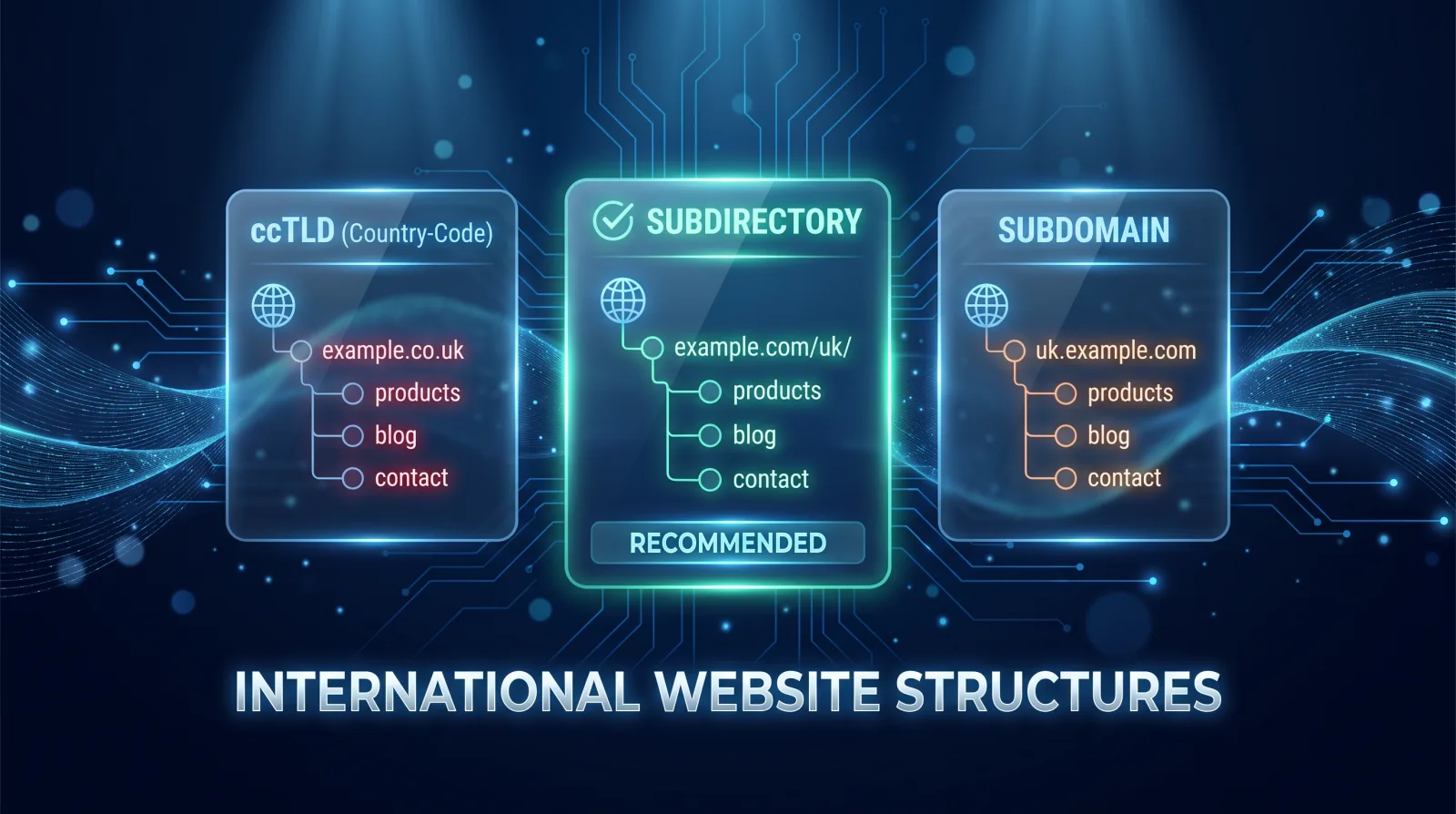
Site structure is the biggest early decision, and there are three main options:
- Country-code domains (ccTLDs) — for example yoursite.de, yoursite.fr. The strongest geo-targeting signal and clearest to users, but the most expensive to build and maintain (each domain earns authority separately).
- Subdirectories — yoursite.com/de/, yoursite.com/fr/. The most popular choice: they inherit the authority of your main domain and are simpler to manage. Usually the best starting point.
- Subdomains — de.yoursite.com. A middle ground, but authority is split more than with subdirectories.
For most UK businesses expanding abroad, subdirectories offer the best balance of SEO strength and manageability. Getting this right from the start matters, because migrating later is costly.
What is Hreflang and Why Does It Matter?
Hreflang is a small piece of code that tells search engines which language and country each page is intended for, so Google can serve the right version to the right person and avoid treating your translated pages as duplicate content.
For example, hreflang can tell Google that one page targets English speakers in the UK (en-gb), another targets English speakers in the US (en-us), and another targets German speakers in Germany (de-de). Get it wrong, with mismatched or missing return tags, and you get the wrong pages ranking in the wrong markets, or none ranking at all.
Hreflang is fiddly and error-prone, which is why it sits firmly in technical SEO territory. Our technical SEO checklist covers the wider technical foundations it depends on.
How Do You Do Keyword Research for International Markets?
The biggest international SEO mistake is assuming customers in other countries search using translated versions of your UK keywords. They rarely do. Different markets use different terms, phrasing and even different search engines.
Proper international keyword research means researching each market in its own language, using local search data, not translating your existing list. A word-for-word translation can target a phrase nobody actually searches, or miss the term everyone uses. Ideally, native speakers validate the keywords and intent.
Our keyword research guide explains the fundamentals; for international work, apply them separately in every target market. This is where localisation begins, and where most DIY international SEO quietly fails.
How Do You Localise Content for Different Countries?
Localisation is far more than translation. It means adapting your content, and your whole offer, to feel native in each market:
- Language and tone — professional, idiomatic translation, ideally by native speakers, not machine translation left unchecked.
- Currency, units, dates and formats — prices in local currency, local date and measurement conventions.
- Local references and examples — case studies, regulations and context that resonate locally.
- Cultural nuance — imagery, colour and messaging that fit the market.
- Local contact and trust signals — local phone numbers, addresses and payment methods where relevant.
Content that feels translated erodes trust and conversions. Content that feels genuinely local wins both rankings and customers, which is why content and localisation go hand in hand.

What Are the Technical Challenges of International SEO?
International SEO is one of the more technically demanding disciplines. The common pitfalls:
- Duplicate content across similar-language versions (for example UK and US English) without correct hreflang.
- Incorrect geotargeting in Google Search Console and inconsistent signals across the site.
- Slow load times abroad if your hosting or CDN does not serve international visitors quickly.
- Crawl and indexation issues as your site multiplies in size across markets.
- Mismatched or broken hreflang return tags, the single most common error.
Each of these can quietly undermine the whole effort, which is why a solid technical SEO foundation is non-negotiable before you scale internationally.
How Do You Build Authority in International Markets?
Ranking in a new country is not just about translated pages, you have to earn authority in that market. A UK domain with only UK backlinks will struggle to rank in France or Germany without local signals.
To build in-market authority:
- Earn local backlinks from publications, directories and organisations in the target country, the job of digital PR.
- Build local citations and, where relevant, local business listings.
- Create genuinely useful local content that attracts links and mentions naturally.
- Encourage reviews from customers in each market.
This is the slowest part of international SEO and the hardest to fake, which is exactly why it is such a durable competitive advantage once built. Our link building guide covers the principles that apply in every market.
How Long Does International SEO Take and How Do You Measure It?
International SEO follows similar timelines to national SEO, but per market: expect 3 to 6 months for early traction in each new country and 9 to 18 months for competitive terms, with authority-building the rate-limiting step. Costs scale with the number of markets, languages and the depth of localisation, so it pays to prioritise the markets with the clearest demand first rather than launching everywhere at once.
Measure each market separately: organic traffic and rankings by country, conversions and revenue per market, and Search Console performance filtered by country. Judge success on in-market revenue, not global vanity traffic. If you are weighing up international expansion, a free audit will show where you already get overseas demand and which markets are the smartest, fastest opportunities to pursue.