
+300%
Online visibility
“Online visibility tripled — the go-to practice in their area”
Manor House Dental
Dr. Jess, Dentist
Dental SEO, Google Ads and practice websites for UK private practices.
Trusted by UK dental practices · scaled since 2019






Pick one, or let us run the lot as a single system. One practice per area, so we never work for your competitor down the road.
Own the three Map Pack slots and the treatment searches that follow.
Implant and Invisalign leads from day one, while SEO compounds.
Fast, GDC-aware sites built so a patient on a phone books.
Before-and-afters that fill cosmetic consultations locally.
Be the practice ChatGPT and AI Overviews name in your town.
A system that earns reviews every week, not in bursts.
Every practice we look at has the same four. Fixing them in the wrong order is why previous agencies failed.
Most practices sit outside the top 3 of the Map Pack for their core treatments, losing the majority of "near me" searches to whoever optimised their profile first.
Google weighs recency, not just totals. A practice with 40 recent reviews routinely outranks one sitting on 200 that stopped collecting two years ago.
Patients searching "Invisalign near me" or "dental implants Birmingham" need treatment-specific landing pages, not a generic homepage that only ranks for the practice name.
GDC advertising standards plus Google's YMYL bar mean clinical content has to be authored by named clinicians with credentials, or it simply will not rank.
Three practices appear when a patient searches for a dentist near them, and those three take the overwhelming majority of calls and direction requests. Everyone else is on page two of Maps, which for practical purposes does not exist.
Switch between the searches to see how it changes, then toggle before and after. This is the shift we build for: not a ranking report, but the position that produces the phone call.
How Map Pack ranking worksPosition 14 — page two of Maps. No impressions, no calls.
A worked example, not client data: it shows how local rank varies across a catchment and what changes when the Map Pack is won. Practice names and figures are illustrative.
Five moments decide whether a patient picks you or the practice down the road. Here is exactly what they see at each one.
Someone within three miles types "dental implants near me" into Google. This happens hundreds of times a month in your catchment, and it is the only moment that matters.
Google shows a map and three listings. Those three take the overwhelming majority of calls. Everyone else is on page two, which for practical purposes does not exist.
They tap through and give you seconds. Is the treatment there? Is the fee visible? Does it load? A slow site with no prices sends them straight back to your competitor.
One tap to call, or a form that takes thirty seconds. No portal login, no "we will get back to you within five working days". The booking has to be the easiest thing on the page.
They attend, they book a hygiene recall, and if you ask at the right moment they leave a review — which lifts you in the Map Pack and brings the next patient in. That is the loop we build.
A growing share of patients never see a results page. They ask ChatGPT, Perplexity, Gemini or Google's AI Overviews for a good dentist nearby and act on the handful of practices named in the answer. Being invisible there is the same problem as being invisible in Maps was five years ago, except almost no practice is working on it yet.
The work is making your practice the citable answer: structured data an AI can parse, clear treatment and pricing information, consistent details across the web, named clinician credentials, and the review signals these systems read as trust.
How AI search optimisation worksIllustrative. Which practices get named depends on reviews, treatment pages and citations.
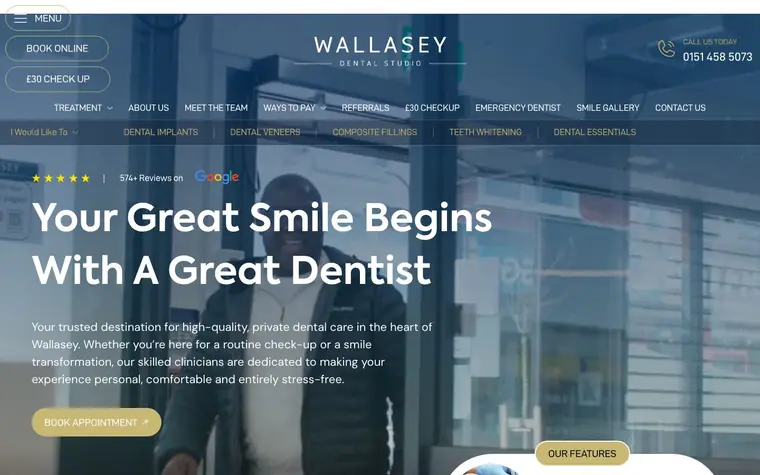
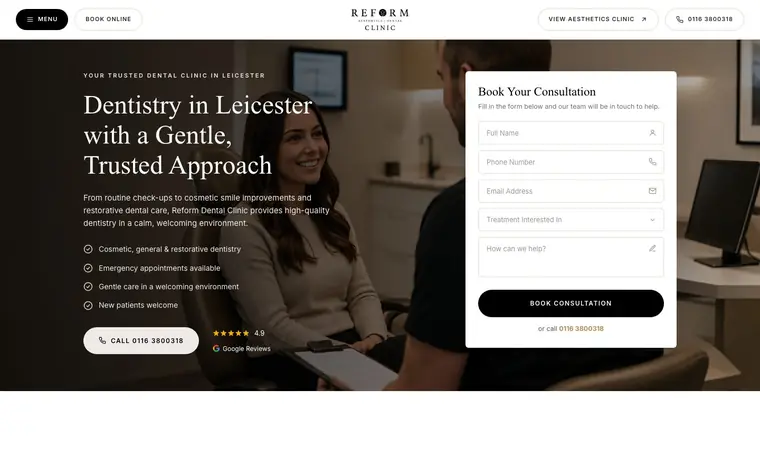
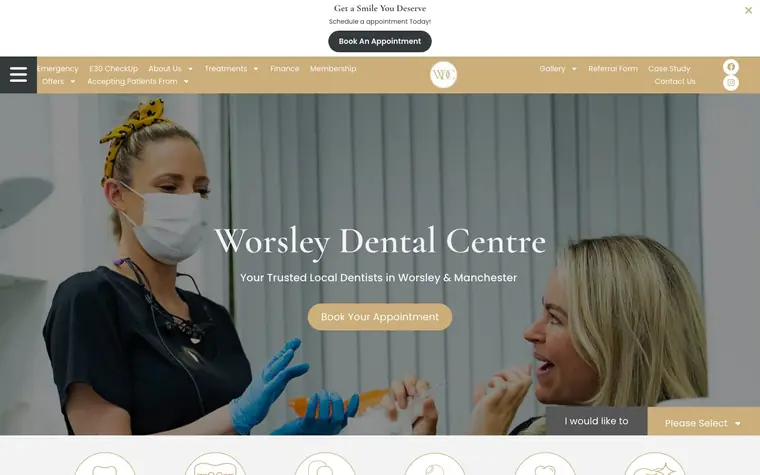
Ranking gets the visit. The site has to convert it. Every one of these puts the treatment, the price and the booking button where a patient on a phone will find them.

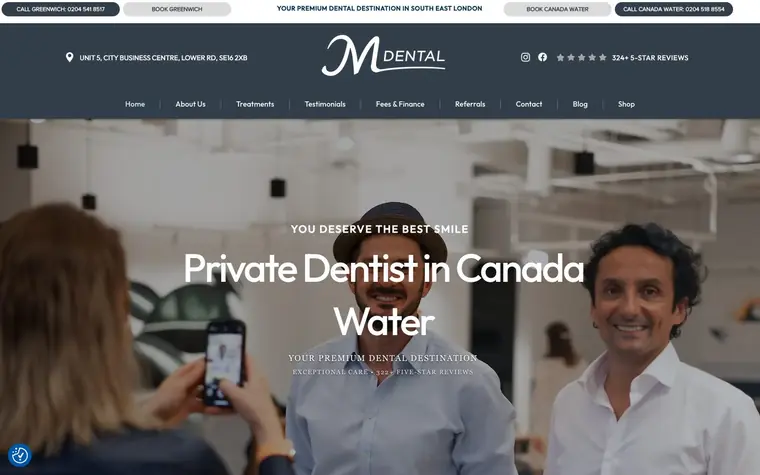
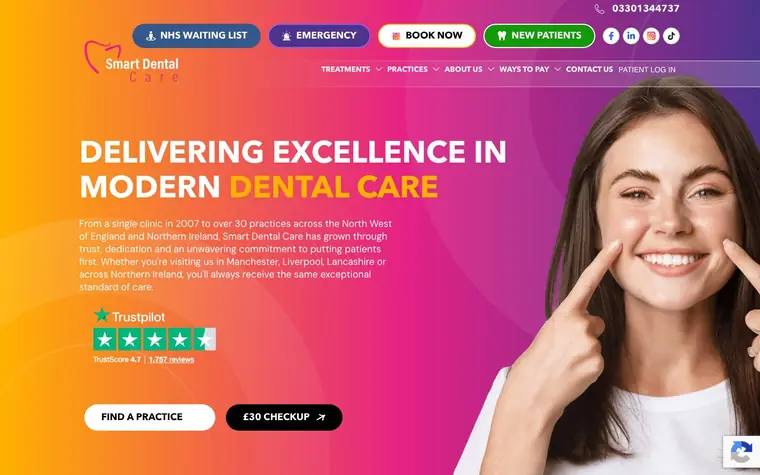
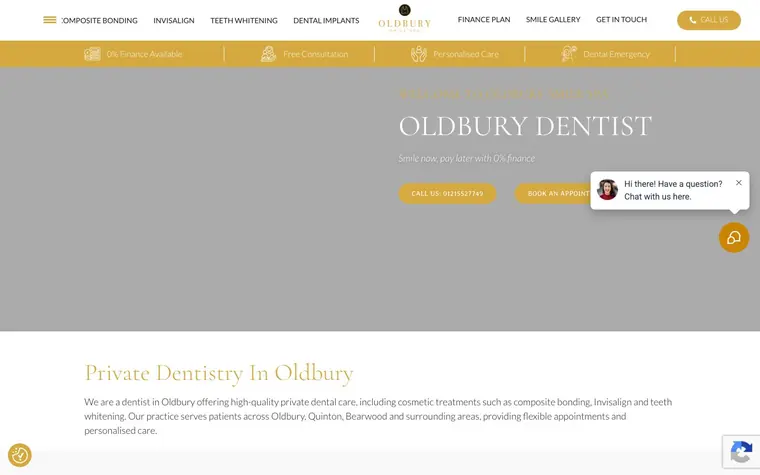
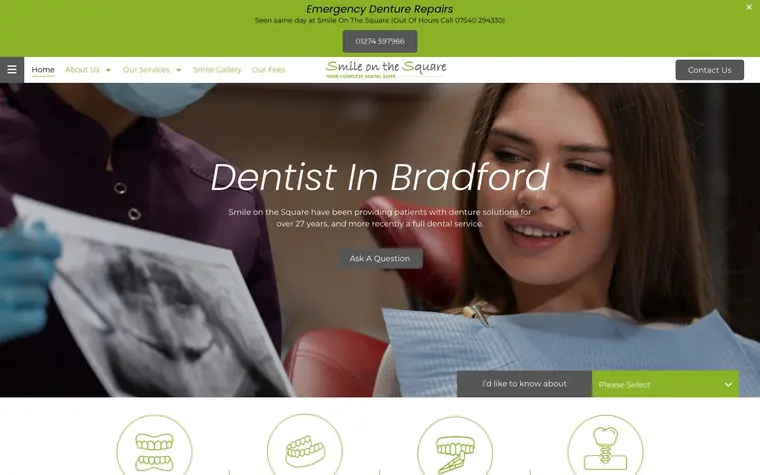
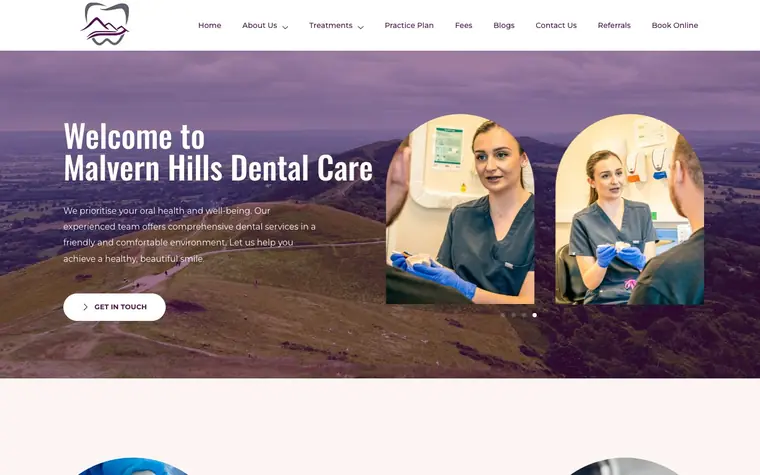
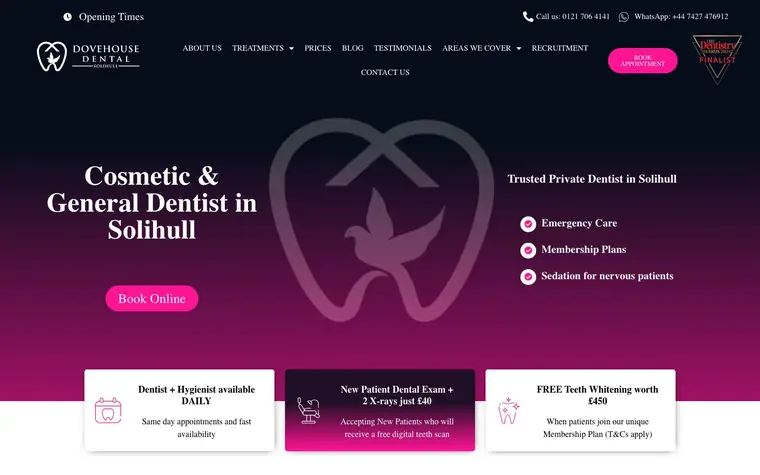
Enter your website. Site speed and on-page SEO come back as live Google Lighthouse readings of your site; Map Pack, reviews and AI presence are indicative estimates. No signup.
Generic practices rank for their own name. Yours should rank for implants, Invisalign and veneers in your city — the searches that bring the highest-value patients.
| Treatment | What patients search | Typical case | Priority |
|---|---|---|---|
| Dental implants | "dental implants [city]", "cost of implants" | from £2,500 | 1 |
| Invisalign | "invisalign near me", "clear braces [city]" | from £2,800 | 2 |
| Porcelain veneers | "veneers [city]", "smile makeover" | from £700/tooth | 3 |
| Composite bonding | "composite bonding", "chipped front tooth" | from £250/tooth | 4 |
| Emergency dentistry | "emergency dentist open now" | same-day | 5 |
Case values are UK private-practice averages. Priority reflects search demand against local competition, and is set per practice at the audit.
Not our words. Practice owners on camera, with the numbers from their own accounts.
“Online visibility tripled — the go-to practice in their area”
“Qualified bookings up 250% from month one”
“Enquiries doubled, ranking page 1 for every treatment”
Marketing spend only makes sense against case value. Move the sliders to your own numbers and see what a realistic uplift in enquiries is worth over a year.
A realistic target is 60–150 by month six. Set it to your own goal.
Reception handling and follow-up speed drive this. Most practices sit at 35–55%.
Average case value £3,200. We assume 22% of new patients take this treatment and the rest are routine, so the blended figure stays realistic.
An illustration using your own inputs, not a forecast or guarantee. Case values are UK private-practice averages, blended across a realistic treatment mix.
Dental SEO is not one lever. It is six that compound, and a practice missing any one of them stalls. This is what the engagement actually consists of, and what it moves.
Page two of Maps. No impressions, no calls, no enquiries.
Top of the pack, and the practice AI engines name when asked.
"Dental SEO" is an abstraction. The work only exists in four places a patient actually looks: the Google Map Pack, your Business Profile, a treatment page in the organic results, and increasingly the answer an AI gives when asked for a dentist.
These are those four surfaces, with a note on each of exactly what we change.
See where your practice standsWhat we change: Google Business Profile fields, review velocity, local citations and proximity signals, so you hold one of the three pack slots.
Representative examples of the four search surfaces we work on. Figures shown are illustrative, not a specific client’s results.
Map Pack first, because it produces enquiries fastest. Everything else compounds behind it.
Geo-grid rank map, Google Business Profile teardown, competitor positions. You see exactly which searches send patients elsewhere.
Most agencies report on impressions and visibility scores. Those move without a single extra patient walking in. Yours leads on calls, form fills and Map Pack positions for the treatments you actually want.
Illustrative report. Figures show the shape of a typical engagement, not a specific practice.
Usually because the work was generic SEO pointed at a clinical site, or because it chased rankings nobody searches for. The audit shows you which searches in your area actually carry patient intent, and what your current position is on each. If the numbers do not support an engagement, we will say so.
Because we report enquiries from month one, not positions. Calls and form fills are trackable immediately, and Google Business Profile calls and direction requests move well before organic rankings do. You will see movement in the leading indicators long before the lagging ones.
Ninety-day rolling terms after the initial period. The Google Business Profile, the treatment pages, the citations and the reviews are all yours and stay yours. We do not hold assets hostage, and there is no long tie-in to sign.
Our own review record and the scope we deliver per engagement. Timeframes are typical, not guaranteed.
Published, because you should not have to sit through a call to find out whether an agency is in your budget. All prices exclude VAT, on 90-day rolling terms after the initial three months.
Single-site practices that are invisible in Maps
Practices growing private treatment revenue
Groups and multi-location practices
We will not guarantee rankings, because nobody controls Google's algorithm and any agency promising otherwise is selling you something they cannot deliver. What we do commit to: a defined scope delivered every month, reporting on enquiries rather than impressions, one practice per treatment per area so we are never working against our own client, and 90-day rolling terms after the initial period. If the audit shows we cannot grow your practice, we will tell you at that stage rather than take the retainer.
Five differences that decide whether dental marketing works or quietly burns a retainer.
We will not take your competitor down the road. When we win the Map Pack slots in your catchment, they stay yours — which is the opposite of how most agencies scale.
We know GDC advertising standards, YMYL content requirements, and which treatment pages convert patients rather than just rank. No learning curve at your expense.
We track calls, form fills and booked consultations, not impressions or visibility scores. Every monthly report leads on patient acquisition.
From first Google Maps impression to booked consultation. Organic, paid, websites and review systems together, so you are not paying three agencies for one outcome.
No twelve-month lock-in. Dental SEO compounds over quarters, so we ask for ninety days to show movement in enquiries, then earn the next ninety on results.
Dentistry sits inside Google's YMYL classification, short for Your Money or Your Life. It means the algorithm applies a materially higher bar for expertise and trust than it would to a restaurant or a plumber, because bad information carries clinical risk. In practice that changes three things. Clinical content needs a named, credentialed author rather than an anonymous blog byline. Claims about outcomes need qualifying language that satisfies both Google and GDC advertising standards. And the trust signals that matter most, reviews and citations from recognised sources, carry more weight than raw keyword targeting ever will.
Clinical pages are held to a higher evidence standard than ordinary local businesses.
For a search with local intent, Google shows three business listings above the classic results, and those three absorb the overwhelming majority of calls and direction requests. A practice can rank first in the organic results and still lose the search, because the patient never scrolls past the pack. Which three appear is decided by a different set of factors from organic ranking: proximity to the searcher, the completeness of the Google Business Profile, review volume and recency, and category relevance. That is why we sequence Google Business Profile work first. It moves fastest, and it is where the enquiries are.
Ranking first organically still loses the search if you are absent from the pack above it.
A patient searching "dental implants Birmingham" and one searching "Invisalign near me" are different people with different budgets, objections and timelines. One page trying to rank for both satisfies neither, and Google can tell. A dedicated page per treatment per city lets each one answer the specific questions that search carries: what it costs, how long it takes, who performs it, what the alternatives are, and what recovery involves. It also creates the surface for treatment-level schema, which is what earns review stars in the results and makes a page citable by AI engines.
Implants, Invisalign and whitening are different searches with different objections.
Google weighs how recently reviews arrived, not just how many exist. A practice collecting four or five reviews a month routinely outranks one sitting on a larger total that stopped growing two years ago, because recent reviews signal an active business. Velocity is also the most controllable ranking factor a practice has: it depends on the request being made consistently at the right moment, not on any technical work. That is why we deploy an automated system, SMS and email requests timed to the appointment plus QR cards at reception, rather than relying on staff to remember.
The smaller, growing profile routinely outranks the larger one that stopped collecting.
A growing share of patients never see a results page at all. They ask ChatGPT, Perplexity, Gemini or Google's AI Overviews for a good dentist nearby, and act on the handful of practices the answer names. Those systems cite sources, which means the work is making your practice the citable answer: structured data an engine can parse, clear treatment and pricing information, consistent details across the web, clinician credentials, and review signals it reads as trust. The foundations overlap heavily with local SEO. The difference is that the output is a recommendation rather than a ranking, and there is no second page to be on.
An AI answer names a handful of practices. Either you are in it or you are invisible.
Map Pack movement typically shows within 6 to 10 weeks, because Google Business Profile and review signals respond quickly. Treatment page rankings usually take 3 to 4 months and compound from there, since they depend on content being indexed, earning links, and accumulating engagement. Anyone promising page one in a fortnight is either bidding on ads and calling it SEO, or has not looked at your competition. We report on enquiries, calls and booked consultations from month one, so progress is visible before the rankings catch up.
Map Pack moves first, which is why we sequence it first. Rankings compound behind it.
Every dental engagement is built from these. Take a look at whichever matters most to your practice right now.
Book a free 30-minute dental audit call. We will review your Map Pack positions, treatment rankings, and competitor gaps, and show you the fastest routes to new patient growth.
No obligation · 30 minutes · GDC-compliant strategy