

Google Ads vs Meta Ads for Lead Generation: Which Wins?
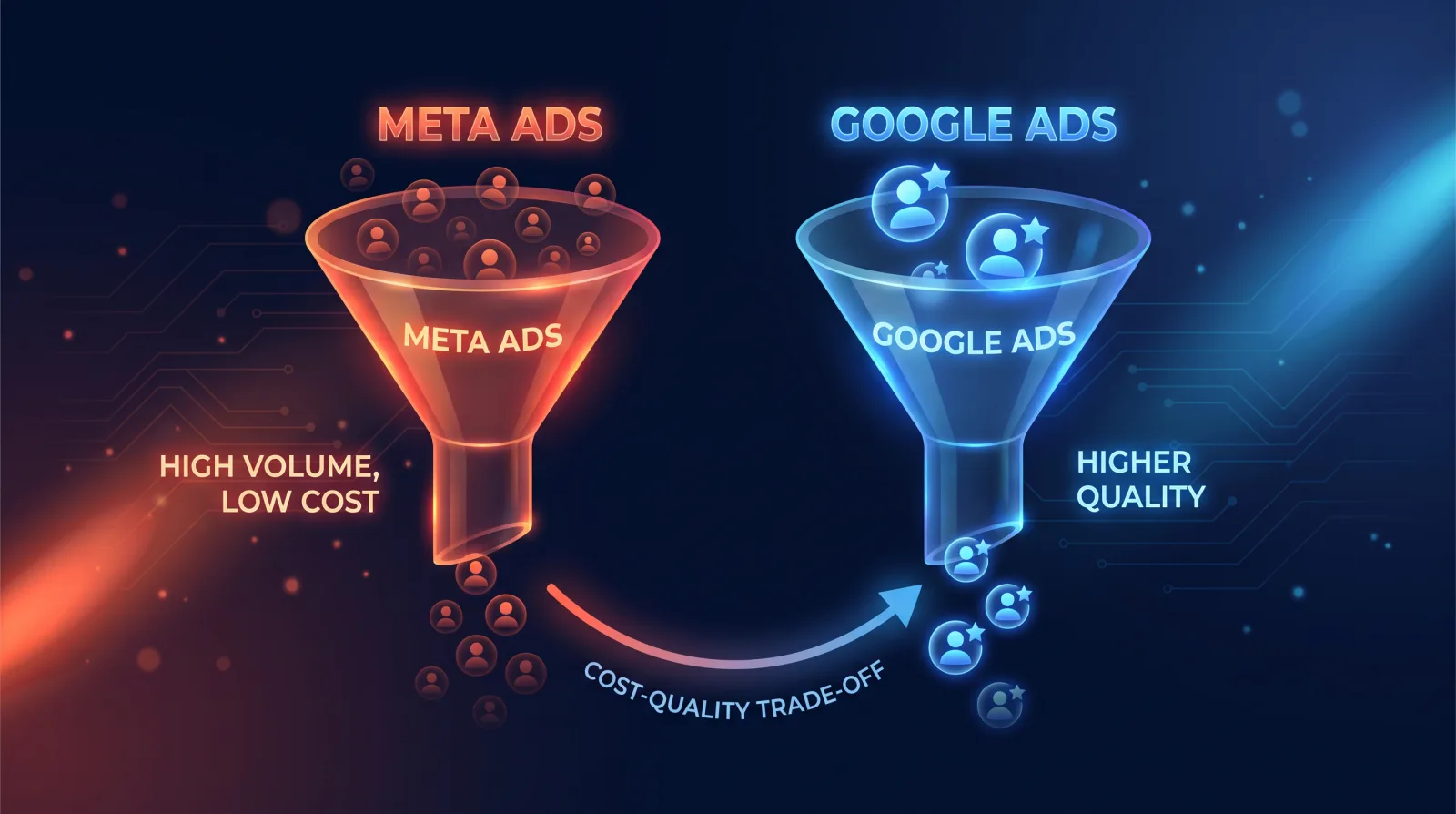
For lead generation, the honest answer is that they win at different jobs. Google Ads captures people who are already searching for your service, so leads tend to be higher-intent and more sales-ready — but they cost more per click. Meta Ads reach people based on who they are, not what they are searching, so they generate cheaper leads at higher volume — but those leads are usually earlier in the buying journey.
For most UK service and B2B businesses, the highest-performing setup runs both: Google to capture existing demand at the bottom of the funnel, Meta to create demand and feed retargeting at the top. This guide focuses specifically on lead generation. For a broader platform comparison across all objectives, see our Meta Ads vs Google Ads guide.
What is the Core Difference for Lead Generation?
It comes down to intent capture vs demand generation.
Google Ads = intent capture. When someone searches "emergency plumber Birmingham" or "commercial solicitor near me", they have a problem right now. Your ad meets active demand. Conversion rates are higher because the need already exists.
Meta Ads = demand generation. On Facebook and Instagram, nobody is searching for you — you interrupt them with a compelling offer based on their demographics, interests and behaviour. You create interest that was not there a moment ago.
For lead gen this matters enormously: Google is fishing where the fish already are; Meta is putting bait in front of fish who did not know they were hungry. Both catch leads, but the leads behave very differently once they reach your sales team.
Which Platform Delivers Cheaper Leads?
Meta almost always wins on raw cost per lead (CPL). Typical UK figures in 2026:
- Meta Ads CPL: £6–£25 for most service and B2C lead-gen campaigns, using lead forms or landing pages. Lower-competition niches can go under £5.
- Google Ads CPL: £20–£80+ for competitive service terms, because clicks cost far more (£2–£50 per click depending on the sector).
So if your only goal is maximum leads for minimum spend, Meta looks like the clear winner. But CPL alone is a trap — a £10 Meta lead that never answers the phone is more expensive than a £50 Google lead that books a £3,000 job. The metric that matters is cost per acquired customer, not cost per lead.
Which Platform Delivers Higher-Quality Leads?
Google Ads typically wins decisively on lead quality for one simple reason: search intent. Someone actively searching for your service is closer to buying than someone who tapped a lead form between Reels.
Signs of the quality gap:
- Close rates — Google leads for high-intent service queries often close at 2–4x the rate of cold Meta leads.
- Speed to purchase — Google leads frequently want to buy this week; Meta leads may be months away.
- Lead-form friction — Meta instant forms are so easy to submit that they attract low-commitment enquiries. Adding qualifying questions improves quality but raises CPL.
The practical takeaway: judge each platform on revenue per pound spent, not lead count. A CRO-optimised landing page and fast follow-up dramatically improve quality on both.
When Does Google Ads Win for Lead Generation?
Prioritise Google Ads for lead gen when:
- Intent is high and immediate — emergency services, legal, medical, trades, B2B software with active buyers.
- Your service is something people search for by name — if there is search volume, there is demand to capture.
- Each customer is high value — a higher CPL is easily justified when a job is worth thousands.
- You need predictable, sales-ready pipeline — Google delivers leads that are ready to talk now.
Google Ads also includes lead-gen-specific formats worth using: Local Services Ads (with the Google Guaranteed badge) for trades and local pros, and lead form extensions on Search. For the full breakdown of how paid search works, see our guide to what PPC is and how it works.
When Do Meta Ads Win for Lead Generation?
Prioritise Meta Ads for lead gen when:
- Your audience does not search for you yet — new categories, disruptive offers, or impulse-led services.
- Volume matters more than immediacy — you have a strong nurture sequence to warm cold leads over weeks.
- Your offer is visual or story-led — before/afters, transformations, events, lifestyle services.
- You want cheap top-of-funnel reach to build retargeting audiences that Google and Meta can both convert later.
Meta's Advantage+ lead campaigns and instant forms make it fast to launch and cheap to test. The catch is follow-up: cheap leads only pay off if you contact them within minutes and nurture consistently. Without that, low CPL just means a bigger pile of leads that never convert.

How Should You Split Budget Between Google and Meta for Lead Gen?
There is no universal split, but these starting points work for UK lead-gen businesses:
- High-intent, high-value services (legal, trades, B2B): start 70% Google / 30% Meta. Capture demand first, use Meta for retargeting and awareness.
- Considered purchases with longer cycles (finance, education, healthcare): 50/50, with Meta building the audience Google closes.
- Visual or impulse services (beauty, fitness, events, home improvement): 40% Google / 60% Meta, leaning on Meta's creative reach.
Whatever the split, ring-fence a small always-on retargeting budget on both platforms — re-engaging warm traffic is consistently the cheapest source of quality leads. If you are still setting overall budgets, our guide to what a digital marketing agency costs covers realistic media minimums.
How Do You Track Lead-Generation ROI Across Both Platforms?
The biggest lead-gen mistake is judging platforms on in-platform metrics. Both Google and Meta will claim the same conversions, and neither knows which leads actually became customers.
To measure real ROI:
- Track leads through to revenue — pass lead source into your CRM and report on closed revenue by platform, not just lead count.
- Use call tracking — a huge share of service leads are phone calls; without call tracking you undercount Google badly.
- Watch cost per acquired customer and ROAS — the only numbers that tell you where the next pound should go.
- Give Meta fair credit — it often creates demand that converts later on Google or direct, which last-click attribution hides.
Proper measurement usually reveals Google driving quality and Meta driving volume and assists — which is exactly why running both, measured together, beats either alone.

Verdict: Which Should You Choose for Lead Generation in 2026?
If you must pick one to start: choose Google Ads when your service has real search demand and each customer is valuable — the lead quality justifies the higher cost. Choose Meta Ads when demand is low, budgets are tight, your offer is visual, and you have the follow-up process to convert cheaper, colder leads.
But "one or the other" is rarely the right long-term answer. The businesses generating the most profitable pipeline run an integrated PPC programme: Google captures the demand that exists, Meta creates the demand that does not, and both feed a shared retargeting and nurture engine — all measured on revenue, not raw leads.
Want to know which split fits your business? Get a free audit and we will model the likely CPL, lead quality and ROI for your specific market before you spend a penny.