

How Do AI Assistants Decide Who to Cite?
AI assistants build answers in two ways: from what they learned in training, and from live sources they retrieve at the moment you ask (this is what powers Perplexity, Google's AI Overviews, ChatGPT search, and Gemini's grounding).
To be cited, you need to win on both fronts — be present and trusted in the live sources they retrieve, and be mentioned often enough across the web that the underlying model already "knows" your brand. In every case the same signals decide it: a clear, extractable answer to the exact question; a source the engine trusts (E-E-A-T); and corroboration from other reputable places.
Getting this right consistently is what our GEO agency service exists to do — but the steps below are the playbook.
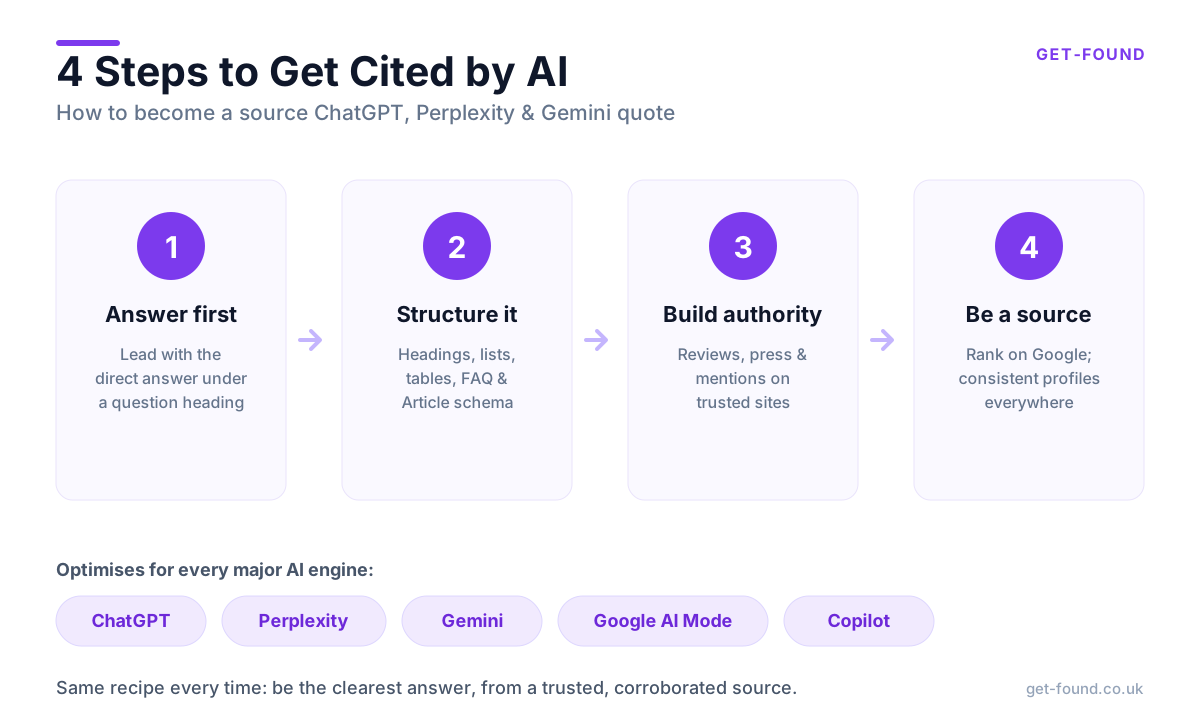
Step 1: Answer the Question Directly and Early
The single biggest lever. AI tools extract the passage that most cleanly answers the question — so put that passage first.
Under each heading, lead with a one or two sentence direct answer, then elaborate. Write your headings as the questions people actually ask ("How much does a website cost in the UK?"), not as labels ("Pricing"). Include the specifics an AI needs to quote you: real numbers, UK context, dates, named examples.
If a person can copy two sentences from your page and paste them as a complete answer, so can an AI. That is the target. This "answer-first" approach is the heart of AEO.
Step 2: Structure Content So Machines Can Extract It
Formatting is not cosmetic for AI search — it is how the model finds your answer.
Use clear H2/H3 question headings. They map directly to user prompts.
Use lists and tables for comparisons, steps, and specs — these are disproportionately quoted.
Add structured data — FAQPage, Article, and Organisation schema tell engines what your content is and who wrote it. Our technical SEO service implements this properly across a site.
Keep paragraphs short and self-contained, so any one of them can stand alone as an answer.
Much of this overlaps with ranking in Google's AI Overviews — see our dedicated guide on how to rank in Google AI Overviews.
Step 3: Build Third-Party Authority
This is the part competitors cannot shortcut — and therefore the biggest edge.
AI models decide what is true by corroboration. If multiple independent, reputable sources say the same thing about your business, the model treats it as fact and repeats it. If only your own website makes a claim, it is discounted.
So you need mentions off your site: coverage in industry publications and local press, listings and profiles on trusted directories, genuine reviews on Google and Trustpilot, and citations from other credible websites. This is exactly what digital PR delivers, and it doubles as backlink authority for traditional SEO.
Reviews deserve special mention: assistants frequently summarise sentiment ("well-reviewed", "highly rated"), so a strong, recent review profile directly shapes how AI describes you.
Step 4: Get Into the Sources AI Actually Reads
Retrieval-based engines pull from a live index, so being present in the places they favour matters:
- Rank on Google for the target question — AI Overviews and several assistants lean on top-ranking pages, so SEO remains foundational.
- Be on Wikipedia-adjacent and authoritative reference sites where relevant to your sector.
- Maintain complete, consistent profiles across trusted directories and platforms (your name, category, and description must match everywhere).
- Publish on your own domain consistently so there is fresh, structured content to retrieve.
Consistency is a ranking factor for machines too: conflicting descriptions of your business across the web make a model less confident about citing you.
Platform Notes: ChatGPT vs Perplexity vs Gemini
The fundamentals are shared, but each has quirks:
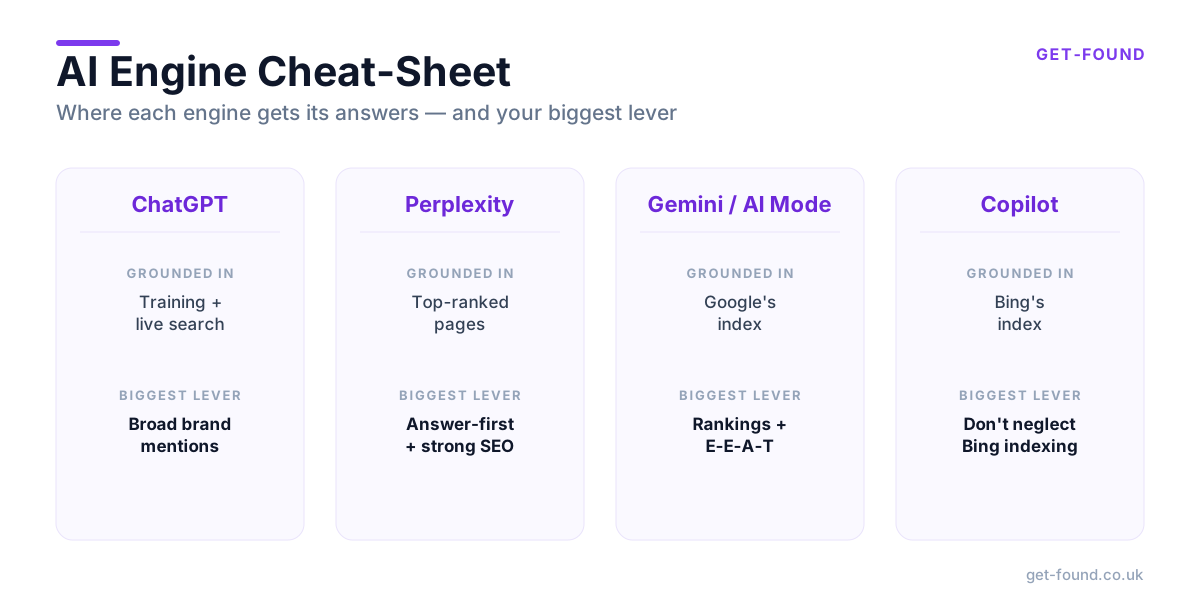
ChatGPT — uses both its trained knowledge and live search. Broad brand familiarity (lots of quality mentions across the web) matters as much as any single page. It cites sources when searching, so authority + rankings both help.
Perplexity — the most citation-heavy engine; it names and links sources on almost every answer, drawing from top-ranking, well-structured pages. Answer-first content and strong SEO pay off here fastest.
Google Gemini / AI Overviews — grounded in Google's index, so classic SEO and E-E-A-T carry the most weight. If you rank and you are structured, you are in contention.
Microsoft Copilot — grounded in Bing; do not neglect Bing indexing and Bing Places.
Across all of them, the winning recipe is identical: be the clearest answer, from a trusted source, corroborated elsewhere. Our AEO and GEO services cover every major platform.
How to Track Whether AI is Citing You
You cannot improve what you do not measure. Practical tracking:
- Run your priority questions through ChatGPT, Perplexity, Gemini and Copilot on a schedule and log whether you are mentioned or linked.
- Watch AI referral traffic in GA4 (ChatGPT, Perplexity and others now appear as referral sources).
- Monitor branded search — a lift often means AI is recommending you.
- Check accuracy — if an assistant describes your business incorrectly, fixing that is a priority GEO task.
We include this monitoring in our GEO programme and can baseline it for you in a free visibility report.

Common Mistakes to Avoid
Burying the answer. If a reader has to scroll past 300 words of preamble, the AI skips you.
Anonymous, generic content. No named author, no credentials, no original data — nothing an engine wants to trust or quote.
Only optimising your own site. Without third-party corroboration, models discount your claims. Off-site authority is not optional.
Ignoring technical basics. If your site is slow or hard to crawl, you are invisible to retrieval — start with technical SEO.
Treating AI search as a one-off. Models and answers change constantly; citation is an ongoing programme, not a project.