

What Does AEO Stand For?
AEO stands for Answer Engine Optimisation — the practice of structuring your content and building your brand's authority so that "answer engines" quote you directly when they respond to a question. An answer engine is any tool that gives a person a direct answer instead of a list of blue links: Google's AI Overviews, ChatGPT, Perplexity, Google Gemini, and Microsoft Copilot.
Traditional SEO earns you a ranking. AEO earns you the citation — the moment an AI says "according to Get-Found…" or lists your page as a source beneath its answer. As more people ask a machine instead of scrolling a results page, being the cited source is quickly becoming as valuable as ranking #1 ever was.
At Get-Found we treat AEO as a discipline in its own right — see our AEO agency service for how we approach it — but it builds on the same foundations as strong SEO.
AEO vs SEO: What's the Difference?
They overlap, but the goal is different.
SEO optimises to rank — to appear as a clickable result on a search engine results page. Success is measured in positions, clicks, and organic traffic.
AEO optimises to be quoted — to be the source an AI pulls its answer from. Success is measured in citations, brand mentions inside answers, and referral traffic from AI tools.
The key practical difference: search engines reward the best page; answer engines reward the clearest, most extractable, most trustworthy passage. An AI does not want your 2,000-word essay — it wants the two sentences that directly answer the question, from a source it trusts enough to name. That changes how you write: lead with the answer, then support it.
Good news for UK businesses already investing in search: strong SEO is the foundation of AEO. If Google cannot crawl and trust your site, no answer engine will cite it either. Your technical SEO has to be solid first.
Why Does AEO Matter in 2026?
Search behaviour has fundamentally shifted. A large and growing share of searches now end without a click — the searcher gets their answer from an AI Overview or a chatbot and never visits a website. This is "zero-click" search, and it is only accelerating.
That sounds like bad news, but it reframes the opportunity: if people are getting answers from AI, you want to be the business inside that answer. When someone asks ChatGPT "who are the best SEO agencies in Birmingham?" or Google "how much does Invisalign cost in Manchester?", the brands named in the response win the trust — and often the click that follows.
AEO is also, right now, low-competition. Most of your competitors are still optimising only for blue links. The businesses that establish themselves as cited sources this year will be very hard to displace, because AI tools develop a "memory" of which brands are authoritative on a topic. Early movers compound.

How Do Answer Engines Choose Which Sources to Cite?
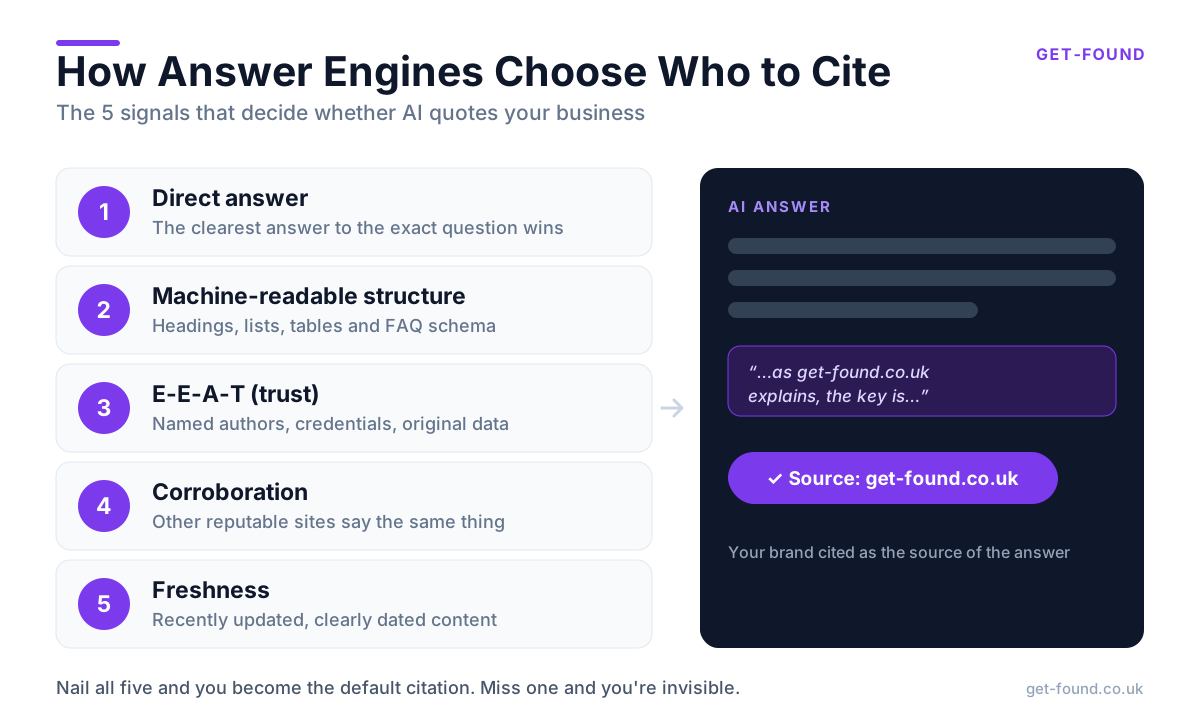
Different engines use different methods, but the signals overlap heavily:
1. Direct, extractable answers. The passage that most cleanly answers the exact question wins. Content that buries the answer under preamble rarely gets pulled.
2. Structure a machine can parse. Clear H2/H3 questions, short answer-first paragraphs, lists, tables, and FAQ schema all make your content easy to extract. This is where schema markup and structured content directly help.
3. E-E-A-T (trust). Experience, Expertise, Authoritativeness and Trustworthiness. Answer engines strongly prefer sources with named authors, credentials, original data, and third-party validation. Anonymous content rarely gets cited on anything that matters.
4. Corroboration. If several independent, reputable sources say the same thing about your brand, an AI treats it as fact. This is why off-site authority — press, reviews, mentions — matters as much as your own pages.
5. Freshness. Answer engines favour recently updated content for anything time-sensitive, which is why our articles carry a visible "last updated" date.
How Do You Actually Optimise for Answer Engines?
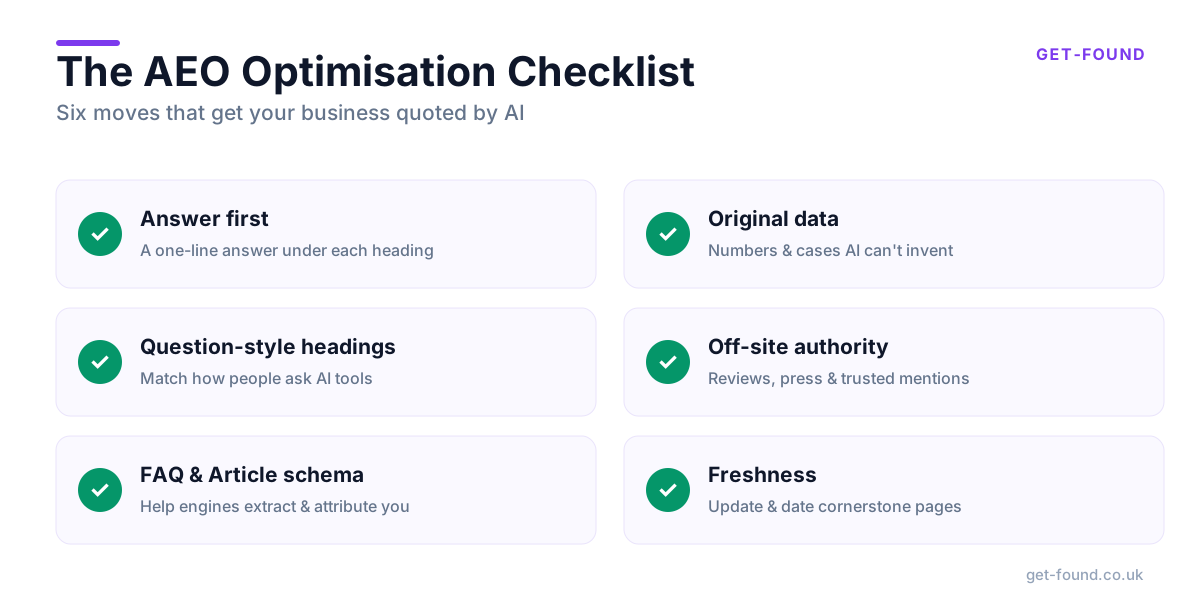
Here is the practical AEO checklist we run for clients:
Answer first, elaborate second. Open every section with a one or two sentence direct answer to the question in the heading, then expand. This is the single highest-impact change.
Write headings as real questions. "How much does SEO cost in the UK?" beats "Our Pricing." It matches how people ask AI tools.
Add FAQ and structured data. FAQPage, Article, and Organisation schema help engines understand and quote you. Our technical SEO service implements this sitewide.
Publish original, first-hand information. Data, case studies, named results, and specific numbers get cited far more than generic advice an AI could generate itself.
Build off-site authority. Reviews, press coverage, and mentions on sites AI already trusts. This crosses over into digital PR and is the hardest part to fake — which is exactly why it works.
Keep it current. Update cornerstone pages regularly and stamp the date.
AEO vs GEO: Are They the Same Thing?
They are closely related and often used interchangeably, but there is a useful distinction.
AEO (Answer Engine Optimisation) focuses on being cited as a source when an engine answers a specific question — the footnotes and "sources" beneath an AI answer.
GEO (Generative Engine Optimisation) is broader: it is about how your brand is represented inside generative AI outputs overall — whether ChatGPT recommends you unprompted, how it describes you, and whether it associates you with the right topics and locations.
In practice you want both, and they share the same levers (extractable content + real authority). If you are weighing them up, our guide on GEO vs SEO breaks it down, and our GEO agency service covers brand visibility across every major AI tool.
How Do You Measure AEO Success?
AEO reporting is newer than SEO reporting, but it is measurable:
- Citation tracking — monitor whether ChatGPT, Perplexity, Gemini and AI Overviews mention or link your brand for your target questions. We run scheduled prompts and log the results.
- AI referral traffic — GA4 now surfaces referrals from ChatGPT, Perplexity and other assistants. Watch that channel grow.
- Branded search lift — when AI recommends you, people then Google your name. A rise in branded search is a strong secondary signal.
- Share of answer — for your priority questions, how often are you cited versus competitors?
AEO is a compounding, long-game investment — much like SEO. The businesses that start building cited authority now will own their category's AI answers well before competitors realise the game has changed. If you want to see where you currently stand, we offer a free AEO audit.