
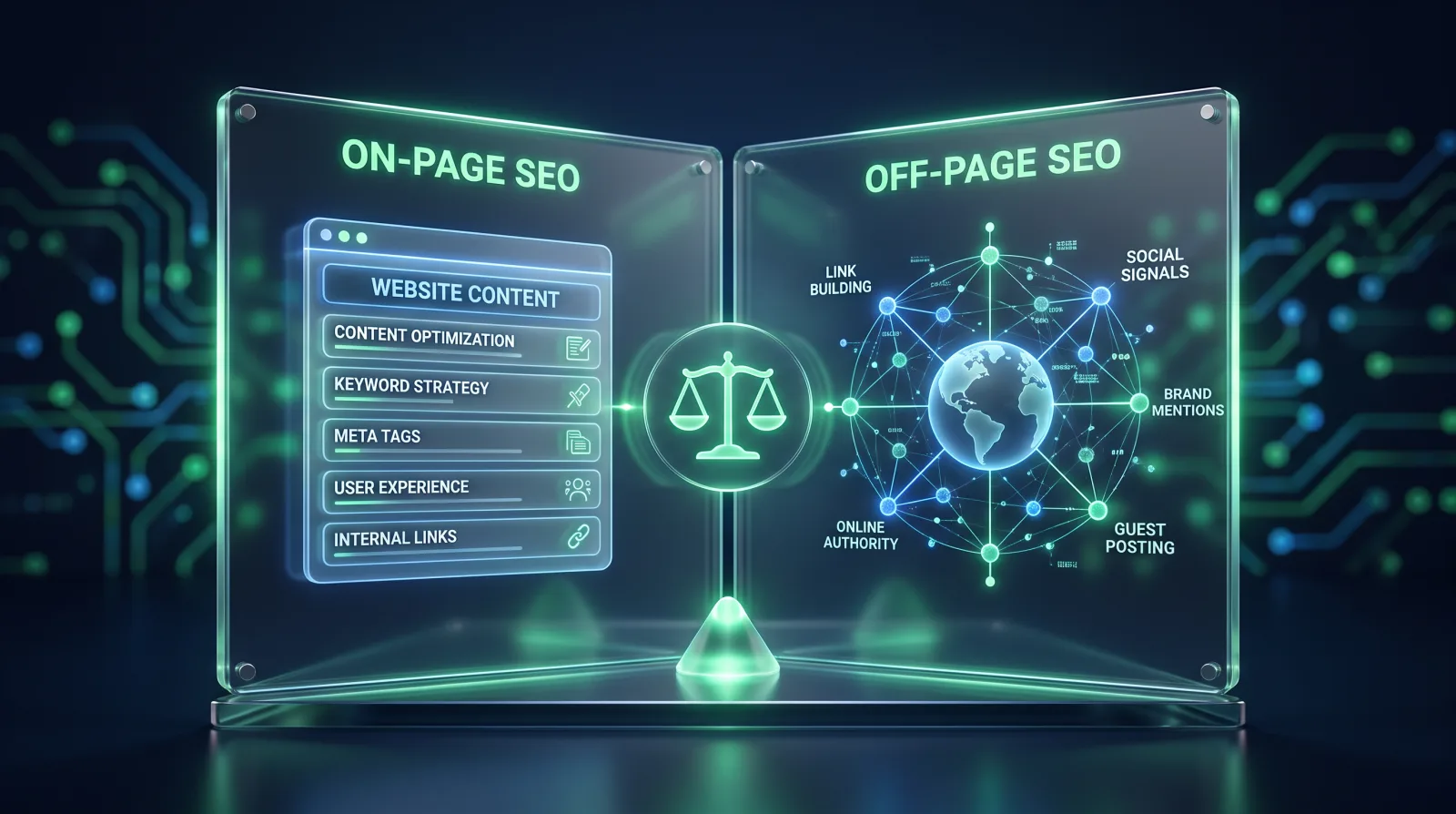
What is the Difference Between On-Page and Off-Page SEO?
The difference is simple: on-page SEO is everything you do on your own website to rank, and off-page SEO is everything you do elsewhere to build your site's authority and reputation.
- On-page = your content, keywords, titles, headings, internal links, page structure and user experience. You control it directly.
- Off-page = links from other sites, brand mentions, reviews and citations. You influence it but do not fully control it.
Think of it this way: on-page SEO makes your site deserve to rank (relevant, useful, well-structured), while off-page SEO makes the wider web vouch for you (authority, trust). Google needs both signals, a great page nobody links to, or lots of links to a weak page, will each underperform. Underneath both sits technical SEO (the foundation that lets Google crawl and understand everything). This guide breaks down each and how to balance them. For the bigger picture, see what SEO is.
What is On-Page SEO?
On-page SEO is optimising the things on your own pages so they rank and convert. It includes:
- Content — genuinely useful pages that match what people search, with enough depth to answer the query.
- Keyword targeting — using the words your customers actually type, in titles, headings and copy (naturally, not stuffed).
- Title tags and meta descriptions — the snippets that appear in search and influence clicks.
- Headings and structure — a clear H1 and logical H2s that organise the page.
- Internal linking — connecting related pages so users and Google can navigate and authority flows.
- User experience — readable, fast, mobile-friendly pages that keep visitors engaged.
On-page is the part of SEO you most directly control, and often where the quickest wins are. Getting each important page clearly focused on one topic, genuinely useful, and well-structured is the foundation of ranking. Our keyword research guide covers the research that feeds good on-page work.

What is Off-Page SEO?
Off-page SEO is everything you do away from your website to build its authority and trust in Google's eyes. The main elements:
- Backlinks — links from other reputable, relevant websites, the biggest off-page factor. Quality and relevance matter far more than quantity.
- Digital PR — earning coverage and mentions from publications and industry sites (see what digital PR is).
- Brand mentions — being talked about across the web, even without a link.
- Reviews and citations — especially important for local SEO.
- Social and community presence — supporting signals and distribution.
Off-page SEO answers the question "does the rest of the web consider you credible?" It is harder and slower than on-page because you do not fully control it, but it is often the deciding factor in competitive markets. It must be earned legitimately, buying spammy links risks Google penalties. Our link building guide covers doing it safely.
Where Does Technical SEO Fit In?
On-page and off-page get the attention, but technical SEO is the foundation underneath both. It makes sure Google can crawl, index and understand your site in the first place, if it cannot, neither your great content nor your hard-won links will help.
Technical SEO covers site speed and Core Web Vitals, mobile-friendliness, crawlability and indexing, site structure, and structured data. Some people count it as part of on-page (since it is on your site); either way, it is essential.
Think of the three together as a stack: technical (can Google access and understand it?), on-page (does the page deserve to rank?), and off-page (does the web vouch for it?). Weakness in any layer holds back the others. See what technical SEO is for a plain-English breakdown of that foundation.

Do You Need Both On-Page and Off-Page SEO?
Yes, and this is the key point: on-page and off-page SEO work together, and neglecting either holds you back.
- Strong on-page, weak off-page: you have great, relevant pages, but without authority you struggle to outrank established competitors in anything competitive. Common for newer sites.
- Strong off-page, weak on-page: you have authority and links, but if your pages are thin, poorly targeted or a bad experience, they still will not rank or convert well.
Google wants both: pages that genuinely deserve to rank and a site the wider web trusts. The right balance depends on where you are, most businesses should nail on-page and technical first (you control them and they are prerequisites), then build off-page authority to compete for the harder terms. Doing one without the other is the most common reason SEO underdelivers.
How Should You Balance On-Page and Off-Page SEO?
A sensible order of priority for most businesses:
- Fix technical foundations — make sure Google can crawl, index and load your site properly.
- Nail on-page — create the right pages, targeting real searches, genuinely useful and well-structured. You control this and it is a prerequisite.
- Build off-page authority — once your pages deserve to rank, earn the links and mentions that let them compete.
Early on, weight your effort toward technical and on-page, because there is no point building links to weak pages. As those mature, shift more effort to off-page to push into competitive positions. It is not a one-time split but an ongoing balance that evolves as you grow.
If you are not sure where your gaps are, whether you need better pages, more authority, or technical fixes, a professional SEO audit will tell you. Book a free audit and we will show you exactly where to focus for the biggest gains.