
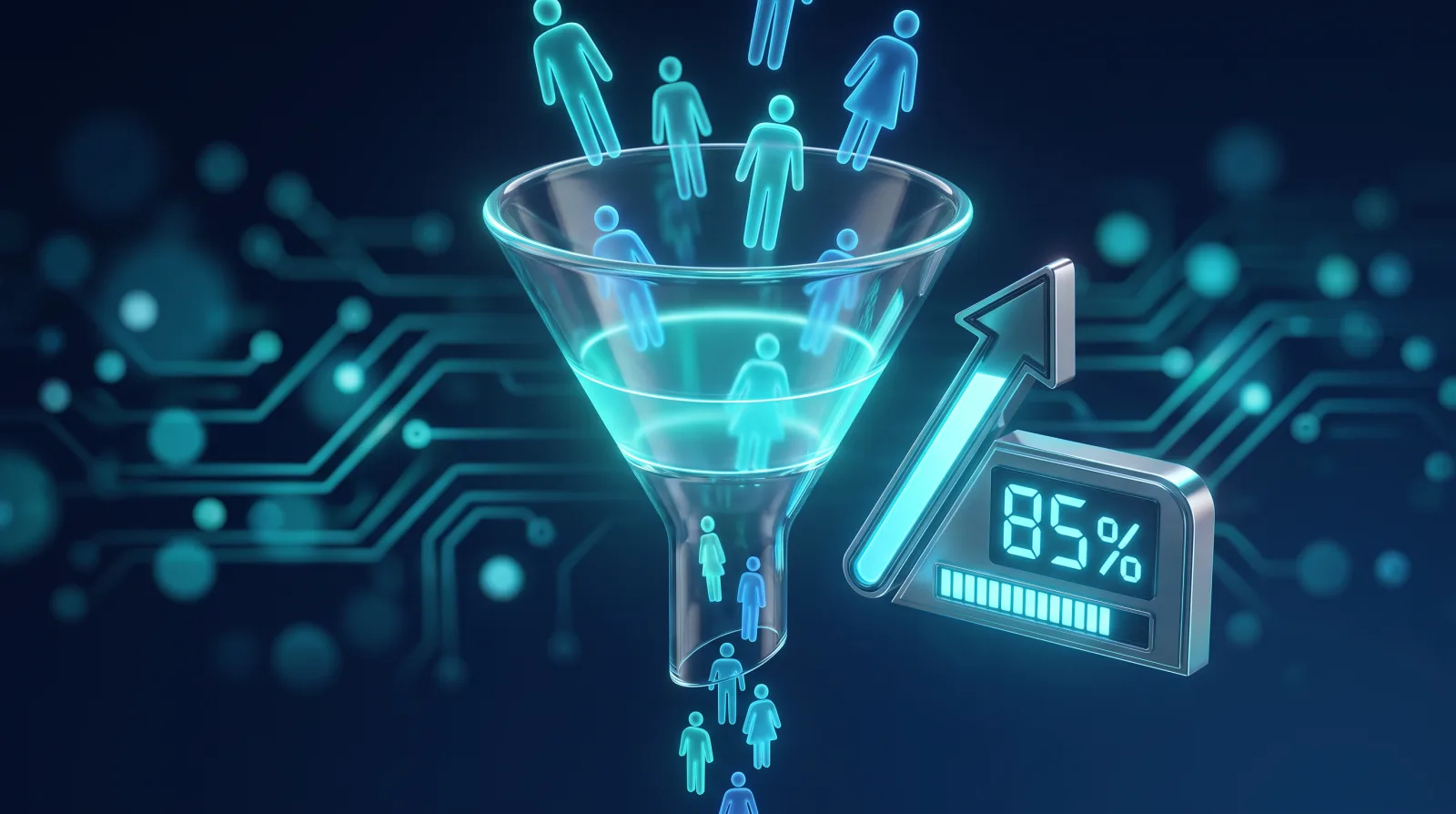
What is a Good Conversion Rate?
A good website conversion rate is usually considered to be around 2 to 5 percent, with the average site converting roughly 2 to 3 percent of visitors. So if 100 people visit and 2 to 3 take the action you want (buy, enquire, book), you are around average; push above 5 percent and you are doing very well.
But "good" is genuinely relative: it depends on your industry, your traffic source, your price point and what you count as a conversion. A 2 percent rate on a high-value B2B service can be excellent, while 2 percent on a cheap impulse product might be poor. The most useful benchmark is almost always your own rate over time, improving it is what grows revenue.
This guide gives realistic benchmarks by industry and channel, shows how to measure your rate properly, and covers practical ways to improve it, the work of conversion rate optimisation. For the fundamentals, see what is conversion rate optimisation.
How Do You Calculate Conversion Rate?
Conversion rate is simple to calculate: (conversions ÷ total visitors) × 100. If 1,000 people visit your page and 30 complete the goal, that is a 3 percent conversion rate.
The important part is defining "conversion" clearly. It can be:
- A purchase (e-commerce).
- A lead — form submission, call, booking or enquiry (service businesses).
- A sign-up — trial, demo, newsletter.
- A micro-conversion — an add-to-cart or a key page view, on the path to the main goal.
You should track conversion rate at several levels: overall site, by page (which landing pages convert best?), and by channel (does organic convert better than paid?). This shows you where you are winning and where you are leaking. Getting this measurement right requires proper analytics and conversion tracking, without it you are guessing. The point is not the single number, it is understanding it well enough to improve it.

What Are Typical Conversion Rates by Industry?
Conversion rates vary widely by sector, so compare yourself to your own industry, not a global average. As rough UK guides:
- E-commerce: typically 1–3 percent (varies hugely by product and price).
- B2B lead generation: often 2–5 percent for enquiries.
- Professional services (legal, accountancy, agencies): frequently 3–6 percent, since visitors arrive with high intent.
- SaaS free-trial sign-ups: commonly 2–5 percent.
- Local services (trades, clinics): can be higher for "near me" traffic with strong intent.
These are ballparks, not targets. A high-consideration purchase naturally converts lower than an impulse buy, and that is fine, because the value per conversion differs. The mistake is chasing someone else's benchmark rather than steadily improving your own. If your rate sits well below your industry norm, that is a strong signal there is easy money to be found in CRO.
Why Does Traffic Source Affect Conversion Rate?
Where your visitors come from dramatically affects how well they convert, which is why a single site-wide number can mislead:
- High-intent search (Google Ads on buying keywords, or SEO for "buy" and "near me" terms) tends to convert best, these people are actively looking.
- Branded and direct traffic (people who already know you) converts strongly.
- Social media often converts lower, users are browsing, not buying, though it builds awareness.
- Display and broad awareness traffic converts lowest, it is cold.
So a low overall conversion rate might not mean a weak website, it might mean a lot of top-of-funnel traffic. Conversely, a high rate might just reflect mostly branded traffic. This is why you should segment conversion rate by channel: it tells you whether the issue is the traffic (wrong audience) or the page (weak conversion). Judging paid channels needs this lens too, see what a good ROAS is.

Why is Conversion Rate So Important?
Conversion rate is one of the highest-leverage numbers in marketing because improving it multiplies the value of everything else you do. Consider: if your site converts 2 percent and you double it to 4 percent, you have doubled your customers and revenue from the exact same traffic, with no extra spend on ads or SEO.
That is why CRO is so powerful. Most businesses pour money into driving more traffic while ignoring the fact that 97+ percent of that traffic leaves without converting. Improving the conversion rate is often cheaper and faster than buying more visitors, and it makes every future marketing pound work harder.
It also compounds with your other efforts: a higher conversion rate means your Google Ads produce more leads per pound, your SEO traffic generates more enquiries, and your whole funnel becomes more efficient. In short, conversion rate is a multiplier on your entire marketing investment, which is why it deserves far more attention than it usually gets.
How Can You Improve Your Conversion Rate?
Improving conversion rate is a systematic process, not guesswork. The highest-impact levers:
- Clarity — visitors must instantly understand what you offer, for whom, and why you. Confusion kills conversion.
- Strong, obvious calls to action — make the next step clear and repeated.
- Trust signals — reviews, results, guarantees, credentials and real photos reduce hesitation.
- Reduce friction — simplify forms, speed up the page, remove unnecessary steps.
- Compelling offer and copy — speak to the visitor's problem and make acting worthwhile.
- Mobile experience — most traffic is mobile; a clunky mobile journey leaks conversions.
- Test, don't guess — use A/B testing and data to find what actually works for your audience.
The core discipline is measuring, forming a hypothesis, testing a change, and keeping what wins. Small improvements compound. This structured approach is exactly what conversion rate optimisation delivers, and our CRO guide walks through the process.

Should You Focus on Conversion Rate or More Traffic?
For most businesses, the fastest wins come from improving conversion rate first, then scaling traffic, though ideally you do both. Here is the logic: it is usually cheaper and quicker to convert more of the traffic you already have than to buy or earn a whole new audience, and improving conversion makes any future traffic investment more profitable.
A simple example: doubling conversion from 2 to 4 percent doubles your results at no extra traffic cost. Doubling traffic while conversion stays weak means paying twice as much to still lose most visitors. So fixing a leaky funnel before pouring in more water is usually the smart order.
That said, the two work together: once your site converts well, driving more traffic through SEO and ads compounds beautifully, because more visitors now means proportionally more customers. The ideal is a well-converting site and growing traffic. But if you have to choose where to start, fixing conversion is often the higher-return move. If you would like to know your true conversion rate and where you are losing customers, book a free audit and we will show you.