
What is a marketing funnel?
A marketing funnel is a simple model of the journey people take from first hearing about you to becoming a customer, and ideally a repeat one. It is called a funnel because many people enter at the top as casual visitors, and a smaller number come out the bottom as buyers.
The point of the model is not to be rigid; real journeys are messier than a neat diagram. The point is to help you see where potential customers are, what they need at each stage, and where you are losing them. Once you can see the funnel, you can fix the leaks, which is usually far cheaper than simply pouring more traffic in at the top.
What are the stages of a marketing funnel?
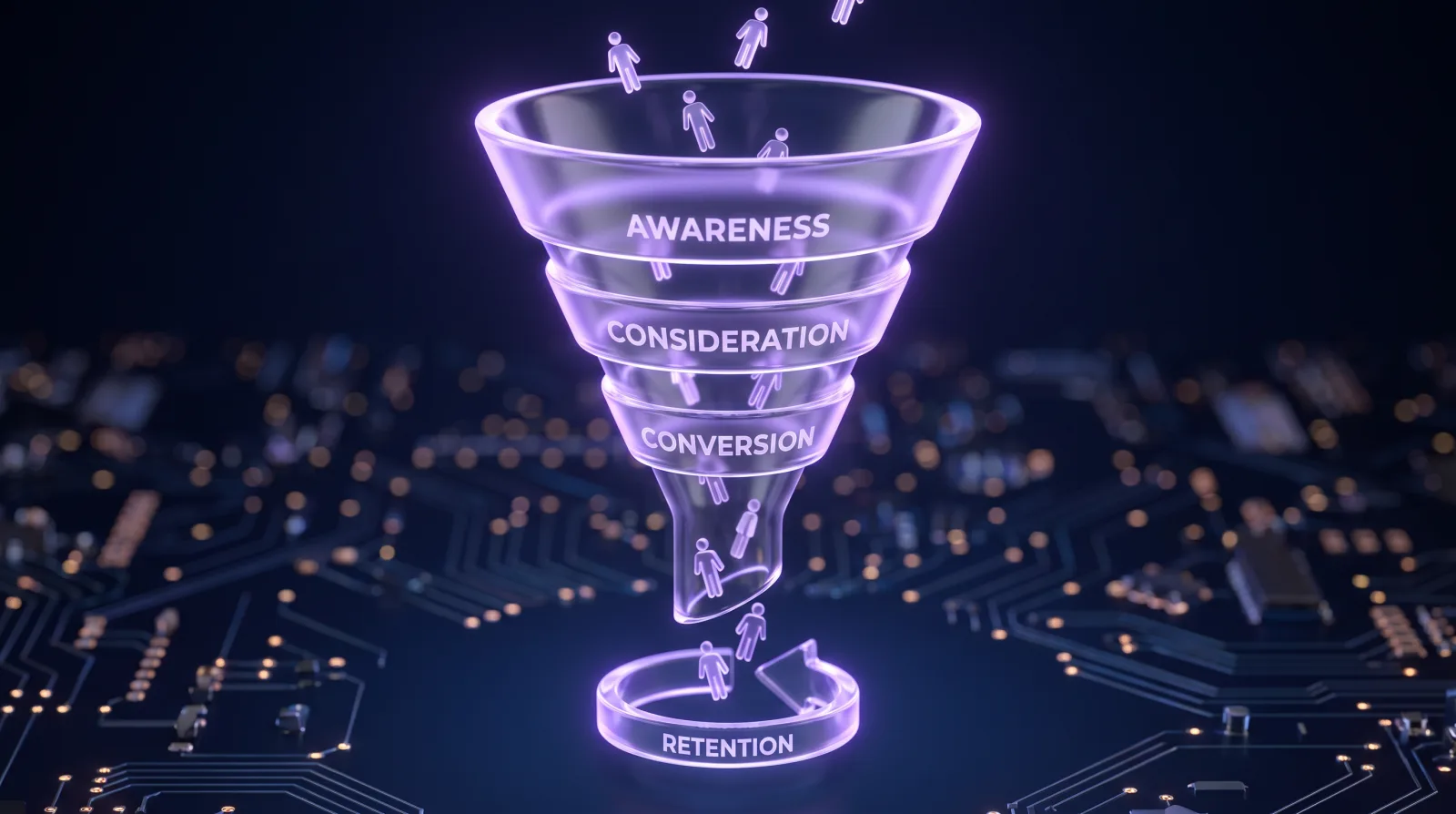
Most funnels are described in three broad stages:
- Top (awareness): people discover you exist, through search, social, ads or word of mouth
- Middle (consideration): they weigh you up, comparing options, reading content and building trust
- Bottom (conversion): they take action, an enquiry, a booking or a purchase
Many businesses add a fourth stage, retention and advocacy, because keeping and delighting customers is cheaper than winning new ones. Each stage needs different content and different measures of success, which is why treating every visitor the same tends to waste money.
Why does a marketing funnel matter?
Without a funnel view, marketing becomes guesswork. You might drive lots of traffic but wonder why few people buy, or generate enquiries that never convert. Mapping the funnel shows you exactly where the drop-off happens, so you can invest where it will actually help.
It also stops you asking too much too soon. Someone who has just discovered you is rarely ready to buy; pushing a hard sell at the awareness stage pushes them away. Matching your message to the stage, helpful content early, reassurance in the middle, a clear call to action at the end, is what turns attention into revenue. This thinking underpins effective lead generation.
How do you build a marketing funnel?
Start by mapping how customers actually find and choose you today, then build content and offers for each stage. At the top, create content that answers early questions and attracts the right people. In the middle, provide comparisons, case studies and reassurance. At the bottom, make it effortless to take the next step with clear calls to action and a smooth enquiry or checkout.
Then connect the stages: capture interest with something valuable, follow up thoughtfully, and remove friction wherever people hesitate. You do not need complex software to begin; you need a clear path and the discipline to guide people along it. Our approach to joined-up digital marketing builds funnels around your real customer journey rather than a template.

What metrics show a funnel is working?
Measure each stage rather than judging everything on final sales. Useful metrics include traffic and reach at the top, engagement and enquiries in the middle, and conversion rate and cost per acquisition at the bottom. Watching how people move from one stage to the next reveals your biggest leaks.
The most valuable insight is often the conversion rate between stages: if lots of people visit but few enquire, the problem is in the middle or on your pages, not the top of the funnel. Fixing that is usually cheaper and faster than buying more traffic, which is where conversion rate optimisation earns its keep.
How does a funnel differ from inbound marketing?
They are related but not the same. A marketing funnel is the model of the customer journey; inbound marketing is a strategy for filling and moving people through it by attracting them with genuinely useful content rather than interrupting them with ads.
Most modern marketing blends approaches: inbound content to attract and nurture, paid channels to accelerate, and conversion work to close. The funnel is the map that keeps it all coherent, so every activity has a clear job. Our guide on inbound marketing explains how the two fit together in practice.