

What is the Difference Between SEO, AEO and GEO?
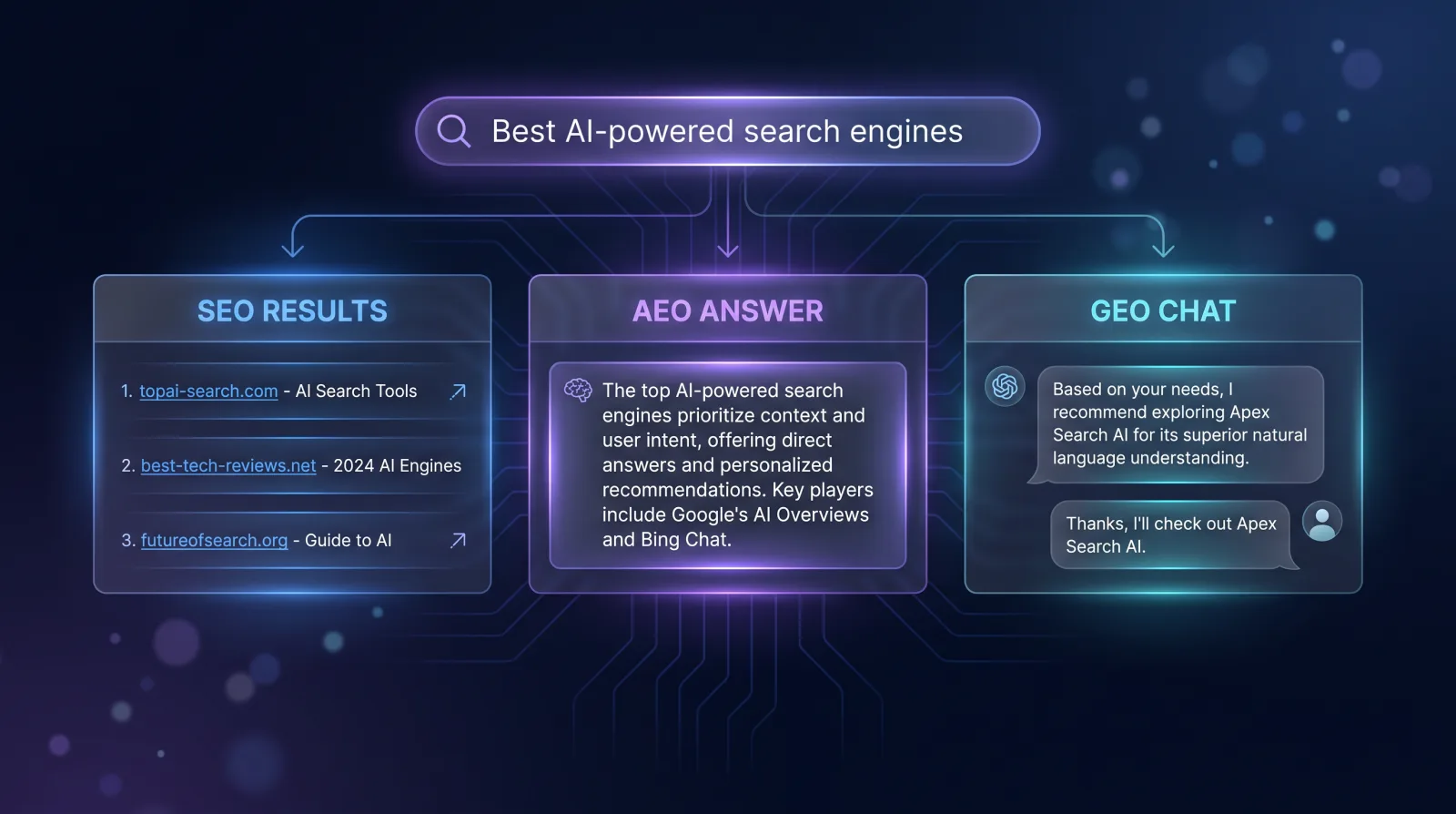
In one line: SEO gets you ranked in Google's blue links, AEO (Answer Engine Optimisation) gets you cited as the answer in AI Overviews and answer engines, and GEO (Generative Engine Optimisation) gets your brand used and recommended inside generative AI answers from tools like ChatGPT and Gemini.
They are not competing strategies — they are three layers built on one foundation. Get the fundamentals right and you can win in all three at once. This is the pillar guide; each discipline has its own deep-dive: start with what SEO is, then what AEO is, then GEO vs SEO. If you only read one section below, make it "Do They Compete or Work Together?".
What is SEO in 2026?
Search Engine Optimisation is the original discipline: improving your website so it ranks higher in traditional search results — the blue links — on Google and Bing. It rests on four pillars: technical health, on-page optimisation, content, and authority (backlinks).
SEO still drives the majority of website traffic, and crucially, it is the foundation the other two disciplines are built on. AI engines overwhelmingly pull from pages that already rank well, so strong SEO is a prerequisite for AEO and GEO, not an alternative to them. If your pages cannot rank, they will not be cited or recommended either. For the full breakdown, see our complete guide to SEO.
What is AEO (Answer Engine Optimisation)?
AEO is optimising to become the cited answer — the source an answer engine quotes when it responds directly to a question. That includes Google's AI Overviews, featured snippets, and voice assistants.
Where SEO aims for a ranking position, AEO aims to be the answer. It rewards content that answers a question directly and early, uses clear question-style headings, includes FAQ and structured data, and demonstrates genuine expertise (E-E-A-T). The payoff is visibility at the very top of the results, above the traditional links. Our AEO agency service and the detailed what is AEO guide cover the how in full, and how to rank in Google AI Overviews shows it applied to Google specifically.
What is GEO (Generative Engine Optimisation)?
GEO is optimising so that generative AI tools — ChatGPT, Gemini, Perplexity, Copilot — use and recommend your brand inside the answers they generate. When someone asks an AI "who is the best X in Birmingham?", GEO is what gets you named.
GEO leans heavily on off-site signals: third-party mentions, reviews, consistent brand presence, and being referenced by sources the AI trusts. You cannot optimise your way in with on-page content alone — the AI has to see you recommended and discussed across the web. Our GEO agency service and the GEO vs SEO guide go deeper, and how to get cited by ChatGPT shows the tactics in practice.
How Do SEO, AEO and GEO Differ in Practice?
The clearest way to see the difference is by what each one is trying to win:
- SEO — Goal: rank in the blue links. Rewarded for: relevance, authority, technical health. Measured by: rankings, organic traffic, conversions.
- AEO — Goal: be the cited answer. Rewarded for: answer-first content, structure, schema, E-E-A-T. Measured by: featured snippets, AI Overview citations, answer-box appearances.
- GEO — Goal: be recommended inside AI answers. Rewarded for: off-site authority, brand consensus, reviews, being referenced by trusted sources. Measured by: whether AI tools name you, and how often.
The search behaviours differ too: SEO serves people who click, AEO serves people who want a quick answer, and GEO serves people who ask an AI to decide for them. Increasingly, the same customer does all three in one journey.
Do SEO, AEO and GEO Compete or Work Together?
They work together — and this is the single most important thing to understand. All three sit on the same foundation:
- Technical health so pages can be crawled, rendered and understood.
- Genuinely useful, well-structured content that answers real questions.
- Authority and trust — backlinks, reviews, brand mentions, E-E-A-T.
Improve that foundation and you lift all three at once. A well-optimised, authoritative page can rank in the blue links (SEO), get quoted in an AI Overview (AEO), and be the source an AI draws on to recommend you (GEO) — simultaneously. Treating them as separate budgets or separate suppliers is the mistake; the businesses winning in AI search run them as one integrated programme. Our take on whether AI Overviews will kill SEO expands on why the foundation matters more than ever.
Which Should Your Business Prioritise in 2026?
Prioritise based on where you are:
- No solid SEO foundation yet? Start with SEO and technical SEO. Without it, AEO and GEO have nothing to build on.
- Ranking already but invisible in AI answers? Layer on AEO — restructure content answer-first, add FAQ and Article schema, sharpen E-E-A-T.
- Want to be recommended by name in ChatGPT and Gemini? Invest in GEO — build third-party authority, reviews and brand consensus through digital PR.
For most UK businesses in 2026 the right sequence is SEO first, AEO close behind, GEO as the compounding long-game — all sharing the same content and authority work rather than running as three separate projects.

How Do You Optimise for All Three at Once?
Because they share a foundation, one well-run programme covers all three. The shared checklist:
- Answer the question directly and early in every piece of content (helps AEO and GEO, and improves SEO engagement).
- Structure for machines — clear question-style headings, short paragraphs, FAQ and Article schema.
- Demonstrate real expertise — named authors, credentials, original data and first-hand experience (E-E-A-T).
- Build off-site authority — digital PR, quality backlinks, consistent citations, genuine reviews.
- Keep it fresh and technically clean — fast, mobile-first, crawlable, regularly updated.
Do these once, properly, and you are simultaneously ranking, getting cited, and becoming recommendable. Optimising for Perplexity and AI Mode shows the same principles applied across engines.
How Do You Measure SEO vs AEO vs GEO?
Each layer needs its own measurement, because traditional analytics miss most of the AI activity:
- SEO — rankings, organic traffic, click-through rate, conversions and revenue. Well served by Search Console and GA4.
- AEO — featured-snippet and AI Overview appearances for your target questions, plus answer-box share. Track which queries trigger AI answers and whether you are the source.
- GEO — whether and how often AI tools name you. This means regularly prompting ChatGPT, Gemini and Perplexity with the questions your customers ask and recording the results, since there is no dashboard for it yet.
The businesses ahead of the curve treat "are we being recommended by AI?" as a KPI, not an afterthought — exactly what we help clients track. For the practical method, see how to get recommended by ChatGPT.

What Does the Future of AI Search Mean for Your Strategy?
The direction of travel is clear: more answers delivered directly, more decisions delegated to AI, and fewer aimless clicks. That does not kill SEO — it raises the bar. The winners will be the businesses that are genuinely authoritative, genuinely useful, and genuinely recommended, because that is what both Google and the AI engines are trying to surface.
Practically, that means stop treating SEO, AEO and GEO as separate trends to chase and start treating them as one thing: building a business the web's trust signals — and therefore the AI's — point to. Get the foundation right and you are future-proofed across every engine. If you want a clear plan for all three, book a free audit and we will show you exactly where you stand across SEO, AEO and GEO.