
How Do You Get Found Online?
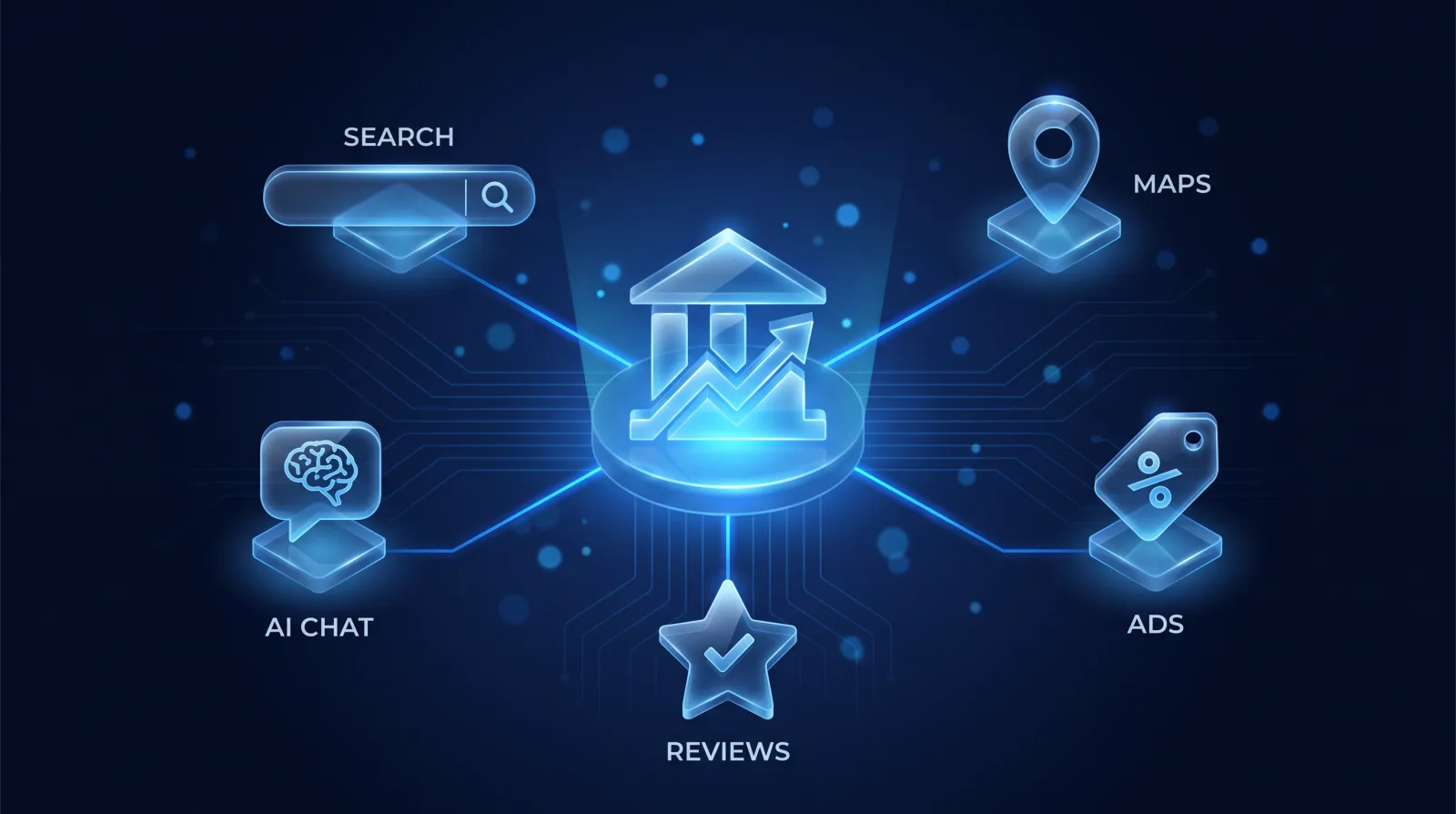
To get found online, your business needs to be visible in the five places customers actually look in 2026: Google search results (SEO), the local map pack and Google Maps (local SEO), AI answers like ChatGPT and Google AI Overviews (AEO and GEO), and paid ads for instant visibility. Underneath all of it sits one thing: a fast, clear, trustworthy website with genuine reviews.
No single channel is enough on its own. The businesses that get found consistently show up across several at once, so that however a customer searches, you are there. This guide walks through each channel and how to win it. If you only do one thing first, fix the foundation, your website and SEO, because every other channel depends on it.
Why Can Customers Not Find Your Business Online?
If you are invisible online, it is almost always one of these reasons:
- No real SEO — your site is not optimised, so Google does not rank it for the terms customers search.
- A slow or unclear website — if it loads slowly or confuses visitors, Google demotes it and customers bounce.
- No Google Business Profile (or an incomplete one) — so you never appear in the map pack or on Maps.
- Few or no reviews — the strongest local trust signal, and you have none.
- Invisible to AI — you are not mentioned or cited anywhere the AI engines trust, so ChatGPT and Gemini never recommend you.
- Relying on one channel — for example paid ads only, so the moment budget stops, you vanish.
The fix is rarely one big thing; it is closing several of these gaps together.
How Do You Get Found on Google Search?
Google search is still where most online journeys begin, and ranking there is the job of SEO (search engine optimisation). It rests on four pillars: technical health (a fast, crawlable site), on-page optimisation (pages that clearly match what people search), content (genuinely useful answers to your customers' questions), and authority (backlinks and reputation).
Start by targeting the exact phrases your customers type, then build pages that answer them better than anyone else. Our complete guide to SEO explains how ranking works, and keyword research shows how to find the terms worth targeting. SEO is a compounding investment: slow to start, but it becomes your most cost-effective source of customers over time.
How Do You Get Found in Local "Near Me" Searches?
For any business serving a local area, "near me" and "in [town]" searches are where the highest-intent customers are, and they are answered by the map pack, the three local listings shown at the top of the results. Winning here is local SEO.
The essentials: a complete Google Business Profile, consistent name/address/phone (NAP) across the web, genuine local reviews, and location-relevant content on your site. Local searches convert at two to three times the rate of general searches, so this is often the single highest-ROI channel for service businesses. Our complete local SEO guide covers the fundamentals, and how to rank in the Google Map Pack breaks down the top three specifically.

How Do You Get Found on Google Maps?
Google Maps is powered by your Google Business Profile, and it is where a huge share of local discovery now happens, especially on mobile. An optimised profile can send calls, direction requests and website visits straight to you, often before anyone visits your website at all.
To get found on Maps: claim and verify your profile, complete every field, choose the right primary category, add real photos regularly, post weekly, and earn and respond to reviews consistently. Our Google Business Profile optimisation guide is the full playbook. A well-run profile is one of the fastest wins in getting found, because it can start driving enquiries within weeks.
How Do You Get Found in AI Answers (ChatGPT, Gemini, AI Overviews)?
More and more customers now ask an AI, "who's the best [service] near me?" or search Google and read the AI Overview instead of clicking. Getting found here is the job of AEO (Answer Engine Optimisation) and GEO (Generative Engine Optimisation).
To be cited or recommended by AI you need answer-first, well-structured content, genuine expertise (E-E-A-T), and, crucially, a strong presence across the third-party sources the AI trusts, reviews, roundups and mentions. AI recommends what the wider web already recommends. Our guides on how to get recommended by ChatGPT and AEO vs SEO vs GEO cover exactly how to win this fast-growing channel, one most of your competitors are still ignoring.
How Do You Get Found Through Paid Ads?
SEO and local SEO compound over months; paid ads get you found today. Google Ads puts you at the top of search the moment someone looks for what you offer, and Meta Ads put you in front of the right people on Facebook and Instagram before they even search.
The smart play for most UK businesses is to run paid ads for immediate visibility and leads while your organic channels build, then rebalance as SEO takes over the cheaper, compounding traffic. Done well, PPC is one of the fastest ways to generate enquiries; done badly, it quietly drains budget on clicks that never convert, which is why measurement and a good landing page matter as much as the ads themselves.
How Important Is Your Website to Getting Found?
Your website is the foundation every other channel depends on. Google will not rank a slow, broken or confusing site; AI will not recommend a business whose site does not clearly say what it does; and paid clicks are wasted if the page does not convert.
The essentials for getting found: fast loading (Core Web Vitals), mobile-first design, a clear structure Google can crawl, and content that immediately tells visitors and machines who you are and what you offer. Our technical SEO service fixes the foundations, and website development builds sites designed to rank and convert from day one. Get this right and everything else works harder.

How Do Reviews and Reputation Help You Get Found?
Reviews do double duty: they help you rank and they persuade people to choose you. In local search, review volume, rating and recency are among the strongest ranking signals for the map pack. In AI search, the businesses with genuine, plentiful reviews are the ones the models see as trustworthy and recommend.
Build a simple, consistent process to ask happy customers for reviews on Google and the platforms that matter in your sector, and respond to every one, positive or negative. Never buy or fake them; it is detectable and it backfires. A strong, growing review profile is one of the clearest ways to get found and get chosen, across search, Maps and AI alike.
How Long Does It Take to Get Found Online?
It depends on the channel:
- Paid ads — instantly. You can be at the top of Google within hours of launching.
- Google Business Profile / Maps — a few weeks to start earning calls and direction requests once optimised.
- Local SEO / map pack — meaningful movement in 2 to 4 months, stronger positions by 6.
- Organic SEO — 3 to 6 months for real traction, longer for competitive terms, but it compounds.
- AI answers — live-search visibility can shift in weeks; durable recommendation builds over 3 to 6 months.
The combination is what wins: paid ads bridge the gap while your organic, local and AI visibility build into a compounding, lower-cost engine.
How Do You Get Found Online Faster?
Prioritise in this order for the quickest wins:
- Fix the foundation — a fast, clear website and clean technical SEO.
- Claim and optimise your Google Business Profile — the fastest local win.
- Turn on reviews — start earning them consistently now.
- Run targeted paid ads for immediate visibility while the rest builds.
- Invest in SEO, local SEO and AI visibility for compounding, long-term growth.
Most businesses are invisible in several channels at once, which is exactly why a competitor with a joined-up approach beats them. If you want to know precisely where you are being found (and where you are not), get a free audit and we will map your visibility across search, Maps, AI and ads, then show you the fastest route to more customers.